How Can
the State’s Dirtiest Beach Also Be Its Cleanest?
Connecticut’s Hole-in-the-Wall Beach in Niantic (East
Lyme) has been pronounced the state’s “cleanest
beach” by Save the Sound, the State’s leading
environmental organization. (See https://www.savethesound.org/beach-report)
But how can the state’s
dirtiest beach also be its cleanest beach?
Without a doubt, Hole-in-the-Wall
is the hands-down dirtiest beach in the Northeast, the most
notoriously harmful to women and children.
After all, it is the receiving
body for the liquid toxic and radioactive waste that the
Millstone nuclear power station produces and releases 24
hours a day, seven days a week, to the surrounding waters,
which happen to be public beaches.
And of 63 nuclear power plants
in the U.S., Millstone is ranked among the dirtiest by none
other than the U.S. Nuclear Regulatory Commission. Read
the 2020 report here: https://www.nrc.gov/docs/ML2316/ML23164A219.pdf
(Tables 3-13 and 3-14. Millstone 3 had the highest releases
of liquid fission and activation products - .372 curies).
No one knows better than
Save the Sound how truly dirty the waters surrounding Millstone
are.
Save the Sound and its legal
staff allied with Connecticut Coalition Against Millstone
back in 2016 to try to persuade the state’s Department
of Energy and Environmental Protection (DEEP) to deny a
federal Clean Water Act permit unless Millstone converted
its cooling system to one which recycled its cooling water
– once contaminated with radionuclides and other deadly
substances – onsite rather than simply dumping it
into the Niantic Bay and surrounding waters.
Deep’s lawyer, Assistant
Attorney General Matthew Levine, suppressed a report advocating
for a closed cooling system and the Connecticut Supreme
Court bought the ruse.
Levine and DEEP allowed Dominion
to dictate the terms of the permit – call it public
corruption if you insist - and Dominion said no to closed
cooling because of its effect on profitability. And that
was that. Save the Sound gave up the fight and now it calls
Hole in the Wall the state’s cleanest beach when it
damn well knows it’s anything but.
The Coalition campaigned
for a closed cooling system after a young mother from East
Lyme (Niantic) gave birth to a baby boy with a jawbone that
had to be replaced because it had been contaminated with
Millstone radioactivity.
The Coalition enlisted Dr.
Helen Caldicott – world-renowned pediatrician and
expert in the health effects of exposure to radiation –
to look into the little boy’s case.
Although his mother was told
by locals that swimming at that beach was a path to delivering
a healthy baby, the opposite was true.
That same year Millstone’s
environmental laboratory caught a fish in Niantic Bay contaminated
with radiation they admitted to the NRC had been dumped
in Millstone discharges.
How could Save the Sound mistake a beach contaminated with
radioisotopes from a nuclear power plant with a beach they
celebrated as healthy for children and other living things?
You’ll have to ask
them.
Antinuclear
Activist Files Suit in Federal Court to Liberate Her Goats;
Claims State Department of Agriculture and Attorney General William
Tong Committed Fraud Upon Connecticut Court
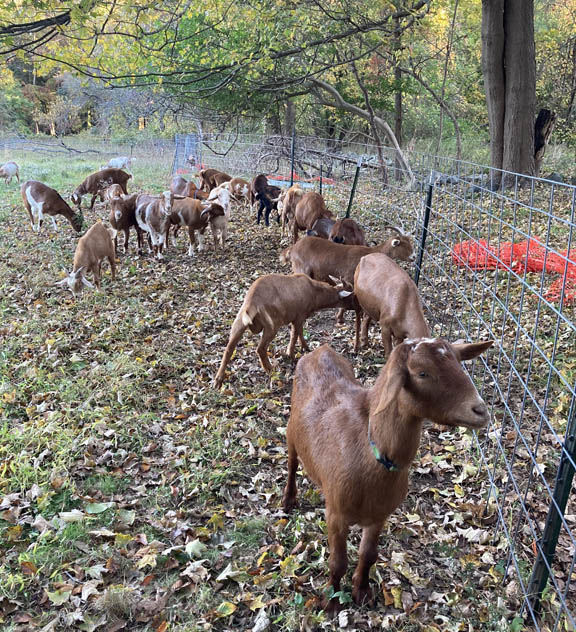
Nancy's goats ate maple leaves not
because they were malnourished but because they love them!
CONTACT: Nancy Burton
203-313-1510 NancyBurtonCT@aol.com
FOR IMMEDIATE RELEASE: JANUARY 2, 2023
Antinuclear activist Nancy
Burton has brought suit in the U.S. District Court in Connecticut
seeking immediate release of all the goats seized from her Redding
property on March 10, 2021 and dismissal of state proceedings
on grounds of fraud upon the Court committed by the Commissioner
of Agriculture and Attorney General William Tong and two of his
assistants.
The case is entitled Nancy Burton v. William Tong et al., 3:22-CV-01591-OAW.
No hearing date has been set.
The suit asserts that Burton’s goats – participants
in the Mothers Milk Project which she co-founded to sample goat
milk for radioactivity – were seized in retaliation for
her antinuclear activism.
It seeks dismissal of state court proceedings on grounds the state
defendants committed fraud upon the Court.
Assistant Attorney General Jonathan Harding asserted in a court
petition that the goats were mistreated; however, the petition
fails to identify a single goat supposedly mistreated, as required
by law, and as a result and for other reasons the Connecticut
courts lack jurisdiction.
Harding, announced his resignation from the office on December
29, 2022, thirteen days after the suit was filed.
State Superior Court Judge Barbara Bellis denied Burton’s
motion to dismiss the case on such basis without conducting the
mandatory hearing or allowing evidence.
Burton staunchly counters that she devoted her heart, her soul
and her resources to the goats and, indeed, the state’s
own witness testified that the goats did not suffer any perceived
medical or health issue supporting the seizure, the pre-requisite
for the court to have jurisdiction.
Many of Burton’s goats have died while in state confinement,
kept under deplorable conditions of overcrowding, nursing infants
separated from their mothers and all the goats deprived of any
human contact for 17 hours straight every single day, including
goats in labor.
The federal defendants have barred Burton from inspecting the
goats or having her experts inspect them and they have withheld
critical information from her and the state court.
The case alleges that Tong, through his deputies and through his
personal oversight, committed a fraud upon the Court to obtain
temporary custody of the goats after an abbreviated hearing on
a relaxed standard of evidence by making false assertions to achieve
their underlying objective: remove Burton from circulation by
blasting her reputation with outrageous, false allegations and
sickening insinuations which she had no reasonable opportunity
to dispute during the abbreviated court hearing.
Burton’s expert witness, a 20-year veteran animal rescuer
with a sterling reputation, Rosa Buonomo, whose Litchfield sanctuary
Stoney Brook Farm Animal Rescue, Inc., is 501(c)(3) certified,
testified in full support of Burton but the Court gave her little
time and completely disregarded her testimony, which was unopposed
by expert testimony.
Tong engaged in an unusually personal attack against Burton in
a press release he issued December 6, 2022; Burton’s suit
contends the press release was deliberately false, defamatory
and unprecedented and issued from a misperception that his conduct
was above the law.
The matter is unfolding just as both the state and federal governments
are revving up to promote a renewal of and expansion of nuclear
power in Connecticut.
In March, the state legislature acted to rescind the 1979 law
placing a moratorium on new nuclear power construction in Connecticut.
Millstone Units 2 and 3 are the sole operating reactors today.
Burton has been a key player in a decades-long statewide campaign
as co-founder of the Connecticut Coalition Against Millstone,
mounting numerous legal challenges opposing a federal license
extension, expansion of the Millstone Unit 2 spent fuel pool,
firing of nuclear whistleblowers and violating the federal Clean
Water Act by corrupting the discharge permit renewal process.
A former reporter with The Associated Press who practiced law
for 20 years, Burton's antinuclear work was all pro bono publico.
Although never the subject of a complaint by a client, she was
disbarred when she raised issues of misconduct by members of the
judiciary; she was told she could be reinstated if she withdrew
the charges while doing so would have been equivalent to committing
perjury.
The Coalition took up the cause of a little boy whose mother swam
in Niantic Bay every day to promote her good health, unaware of
Millstone’s continuous discharges of radioactive and toxic
waste discharges to the Bay and its surrounding public beaches.
He was born with cancer in his jaw. Renowned Nobel Peace Prize
nominee Dr. Helen Caldicott spoke at a press conference with the
little boy, linking his cancer with Millstone releases. The Coalition
donated signs to the Selectmen of East Lyme to post at the Hole-in-the-Wall
Beach warning of the health risks, but the Selectmen hid the signs
in a Town Hall closet and called the police who, unbeknownst to
the Selectmen, pulled Burton aside and offered her their encouragement.
Burton succeeded in 1999 in persuading a state court judge to
keep Millstone Unit 2 shut for 10 days – an unprecedented
act costing the plant’s owner an estimated $1 million per
day – to spare losses to the indigenous fish population
which would otherwise be sucked into the plant’s intake
structure and destroyed, hastening the subspecies’ march
to extinction.
The state’s lead attorney opposing Burton and her environmental-activist
clients in the case, Fish Unlimited v. Northeast Utilities Service
Company, Inc., CV-99-058927-S, and sharing a counsel table with
Millstone’s attorneys, was Matthew Levine, who has since
been elevated to deputy attorney general and is lead attorney
in the case against Burton and her goats. Levine is a defendant
in Burton v. Tong.
Among other facts, the federal complaint asserts that Tong and
his staff members Levine and Harding willfully withheld from their
witnesses the facts and significance of an investigation report
by the then-state veterinarian, who, after evaluating all of Burton’s
goats and her goat care and inspecting her property, dismissed
a neighbors’ complaint as unwarranted on June 15, 2018,
concluding that Burton provided all appropriate care to the goats
and all were healthy.
Burton’s neighbor, Elinore Carmody, agitated the community
and news media with absurd claims about the goats, such as that
the goats made loud noises because Burton was physically abusing
them when in fact the goats were in a breeding cycle when such
goat sounds are normal and Burton’s property is zoned for
agricultural uses. Carmody roused the town with false accusations
the goats were “malnourished” on grounds she observed
them eating leaves and pasture vegetation, which are essential
to goats’ unique digestive processes.
Carmody messaged death threats to Burton and harangued state court
personnel.
Carmody also allied herself with then-State Senator Will Haskell,
who wrote an inflammatory letter to Agriculture Commissioner Bryan
Hurlburt complaining that Burton kept more than 100 goats. At
his deposition, Haskell walked his comments back, admitting he
counted only two dozen goats during his single 20-minute observation
from Carmody’s property and that he knew “nothing”
about goats nor their natural behavior and made no effort to contact
Burton before demanding that Hurlburt remove Burton’s goats.
Carmody gained news media entree by introducing herself as the
first publisher of the short-lived “George” magazine
launched by John F. Kennedy, Jr.; As publisher, she was charged
with selling advertising space, frequently to liquor manufacturers.
However, as advertising sales declined, she was “let go”
and the magazine soon folded.
Burton adopted Katie the Goat (www.Katie.the.Goat.org) when she
discovered the state had been monitoring her milk for radioactivity
when she grazed five miles downwind of Millstone nuclear power
station in Waterford, Connecticut. Her milk contained alarming
concentrations of radioisotopes routinely released by Millstone
into the air and accumulating in the environment as fallout.
Katie gained fame when she visited the State Capitol for a press
conference about her contaminated milk and later to the White
House in 2012 after then-First Lady Michelle Obama, through her
press office, graciously declined Burton’s offer to adopt
one of Katie’s granddaughters as a White House pet and personal
radiation monitor, while praising the Mothers Milk Project as
“fantastic” in its mission and wishing it success.
Katie died of thoracic cancer shortly thereafter.
Burton was still operating the Mothers Milk Project (www.MothersMilkProject.org)
when her goats were seized and expanding it geographically to
create a database of goat and human milk sampling to raise public
and governmental awareness of the science-based reason to shutter
nuclear power plants: to safeguard the public health. After the
nuclear defense industry, health care – much of it cancer-related
- is southeastern Connecticut’s largest employer. Many of
the milk samples from goats as well as humans contained strontium-89
and strontium-90. Strontium-89 is considered a definitive marker
for a nearby recent release as it has a very short half-life.

Honoring Justice
Dennis Eveleigh

On November 10, 2022, Hon. Justice Dennis Eveleigh
ordered the Connecticut Office of the Attorney General to
take all necessary steps and precautions to preserve the lives
and good health of all the goats seized by the Connecticut
Department of Agriculture from Nancy Burton on March10, 2021
until further order.
Justice Eveleigh, retired Justice
of the Connecticut Supreme Court, entered the order during
a preargument conference over which he presided at the New
Haven Superior Court.
The Mothers Milk Project and
all the innocent and much-loved goats recognize and honor
Justice Eveleigh for his outstanding and enlightened action.
Nancy
Burton
Co-Founder Mothers Milk Project
MothersMilkProject.org
Posted: November 14, 2022
Why are these goats
calling out "I can't bleat"?

Why is
this person smirking? Return to this site as this ghastly true
story of official animal cruelty and public corruption in Connecticut
unfolds...
|


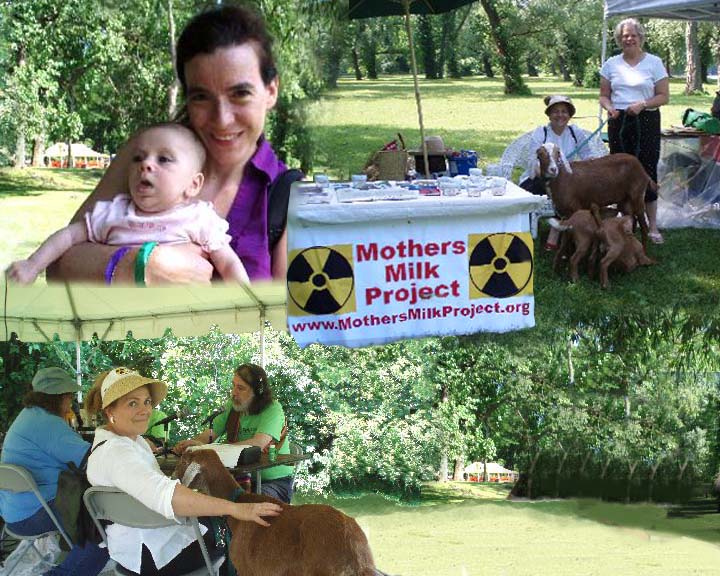
Mothers Milk Project
at Clearwater Festival

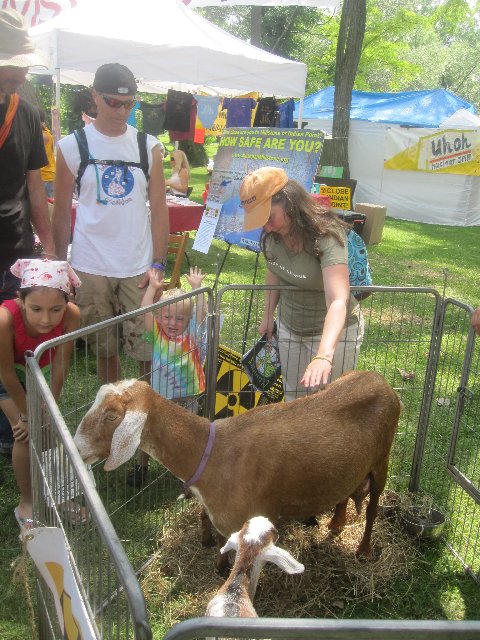
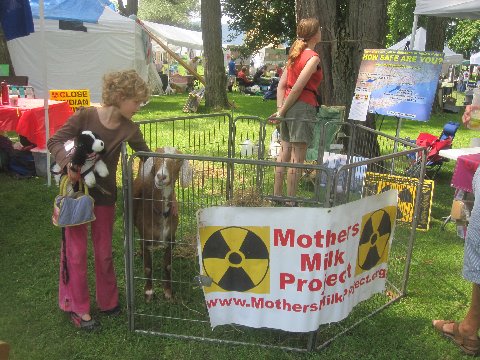 
We launched the Mothers Milk Project with
a press conference in New Canaan CT on June 5, 2008 with the help
of three goats – Cindy-Lu and her kids, Hannah and Henry
- and two young breastfeeding mothers.
The goal: to draw attention to the scientific link between the
routine 24/7 releases of radiation to the air by the two Indian
Point (“IP”) nuclear reactors and the disturbing high
incidences of cancer occurring downwind of the Hudson River plant.

Neither New York State
nor IP’s owners ever sampled goat milk; milk sampling was
limited to one dairy farm five miles to the northeast. Milk sampled
from that location between 1982 and 1992 spiked at 14 picocuries
per liter of Strontium-90 in 1983 and 7.25 in 1991, when the dairy
farm closed. Human breast milk was never sampled. The Mothers Milk
Project stepped in to fill the information vacuum. (The nuclear
industry itself credits goat milk as the most reliable biological
indicator of radiation in the environment.)
We set up colorful and fun exhibitions
at Pete Seeger’s annual Clearwater and Strawberry Festivals
with our beautiful goats and their nursing kids. (See photo display
above) The child-friendly exhibit encouraged lactating mothers to
donate samples of their breast milk for analysis at an independent
laboratory. Many did. Along with the goat milk, human mothers’
milk samples came back with measurable levels of the two radioisotopes
we tested for– strontium-90 and strontium-89 – released
during routine nuclear power plant operations.
For example, breast milk from a Hudson
River Valley mother in 2009 had a concentration of 3.3 picocuries
per liter of strontium-89. Because strontium-89 has a half-life
of only 50 days – half of its radioactivity has decayed by
the 50th day – its presence and detectability in a human milk
sample is a scientifically conclusive indicator that the milk was
contaminated with radioactivity by a recent fission event not very
far away – where else but Indian Point?
With the radiation releases come heightened cancer levels: cancer
incidence in Fairfield County, Connecticut – closest to Indian
Point - was 8 per cent and 7 per cent above the U.S. rates for males
and females respectively; the Fairfield County cancer death rate
for those under 25 was 4 per cent above the U.S. rate.
VICTORY:
INDIAN POINT TO PRMANENTLY SHUT DOWN ON APRIL 30, 2021!
As we continued testing
goat and human milk, we called for the shutdown of Indian Point.
The good news: Indian Point Unit 2 permanently shut down in 2020;
Unit 1 had shut down in 1974. As of this posting – April 24,
2021 – Indian Point has six days to go before it too is permanently
shut down following waves of civic activism and New York State’s
tough stand on IP’s Clean Water Act permit (denying renewal
because its once-through cooling system was outmoded and environmentally
destructive). Visit Riverkeeper.org to watch a real-time historic
second-by-second countdown to shutdown.
NOW: MOTHERS MILK PROJECT
TAKES ON MILLSTONE!
Mothers
Milk Project now focuses on the Millstone nuclear power station
in Waterford, Connecticut, notorious for its excessive radiation
releases and the high cancer rates in the communities surrounding
Millstone (not to mention its Clean Water Act permit, recently renewed
by DEEP despite its use of the same cooling technology as New York
State declared was too antiquated and environmentally destructive).
Connecticut’s DEEP (Department
of Energy and Environmental Protection) has discontinued what had
been a decades-long program of sampling dairy cow and goat milk
and having it analyzed for radioactivity levels. The winner? Millstone
and its investors. The losers? The public, especially women and
children, the most vulnerable, living nearby.
Goat milk which had been sampled
at a location in a residential neighborhood five miles downwind
of Millstone was alarmingly high in strontium-90 concentrations,
recorded as high as 44.4 and 55.5 picoCuries per liter; cancer cases
plague the neighborhood.
Equally alarming, the last data released
by DEEP dated October 3, 2017, recorded a concentration of .48 picoCuries
of strontium-89 from goat milk collected two miles downwind of Millstone
in a residential neighborhood in Waterford. The data also revealed
sr-89 concentrations in four other goat milk samples from the same
location: 2.00, 1.00, 2.00 and 1.00. Repeat: sr-89 is exceedingly
difficult to detect and measure because of its brief half-life.
DEEP has terminated its cow and goat milk sampling because it claims
it is unaware of any lactating cows or goats grazing within 10 miles
of Millstone. (For years, DEEP used to sample cow/goat milk at locations
beyond 10 miles from Millstone, frequently reporting positive results.)
Time for the mothers and the goats
in Connecticut to step in: especially those living downwind of Millstone
in southeastern Connecticut.
If you are a lactating mother and would like to have your milk tested
for sr-90 and sr-89,
please contact us at: info@mothersmilkproject.org.
If you have a goat or would like to adopt
a goat to contribute goat milk samples,
please contact us at: info@mothersmilkproject.org.
If you are not a lactating mother and cannot adopt a goat but still
want to help, please make a financial donation and mail it to:
Mothers Milk Project, c/o Nancy
Burton, P.O. Box 227, Redding Ridge CT 06876
And please follow this site for updates!
Mothers Milk Project is Launched:
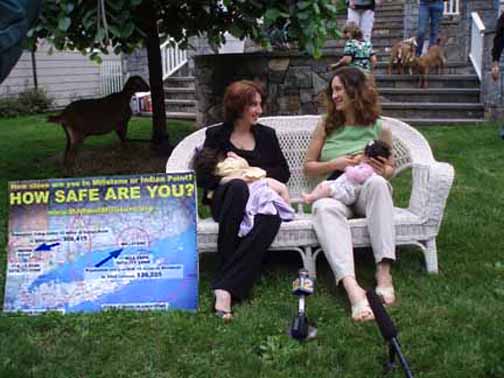 PRESS
CONFERENCE New Canaan, Connecticut PRESS
CONFERENCE New Canaan, Connecticut
June 5, 2008
The Mothers Milk Project is being launched
on June 5, 2008 to begin a systematic sampling of mothers milk produced
by humans and other mammals living within 50 miles of the Indian Point
Nuclear Power Station in Buchanan, New York.
Indian Point's owner and the New York
State Department of Health stopped sampling cow's milk near Indian
Point in 1991 and have never tested human breast milk.
The project is an unpredecented campaign
to create a database of findings of the potential presence of radioisotopes
in milk of mammalians, including humans, near the nuclear power plant.
Indian Point, in common with all nuclear
power plants, is designed to routinely release fission products into
the air. These include strontium-90, which has a half-life of 30 years
and remains biologically active for 600 years. Strontium-90 mimics
calcium in its chemical composition and is readily taken up by bone
cells and teeth, where it continuously emits pulses of energy which
disrupt the functions of nearby cells. Strontium-90 exposure is linked
to bone cancer, leukemia, diseases of the immune system and cancer
of soft tissue including breast and lung. Strontium-90 is only one
of more than 100 radioisotopes routinely released by Indian Point.
All are carcinogens and all.are most harmful to young children and
developing babies.
We encourage breastfeeding mothers
to participate in this program by donating a cup of their breast milk
monthly. Each sample will be divided into four parts: one for the
New York State Department of Health, one for Entergy, Indian Point's
owner, one for the project's independent laboratory, and one to be
retained by the project. There is no cost and all samples will be
taken confidentially with results anonymous.
The Mothers Milk Project will also include dairy cow and goat milk
samplings. Other mammals may be included as well.
The Mothers Milk Project is designed to inform the community about
a known hazard - radiation - which is insidious because it cannot
be seen, tasted, smelled or detected except with sophisticated equipment
and which is biologically harmful at any degree of exposure.
Please return to this website for future updates.
To donate milk to the Mothers
Milk Project, email us! DONATE@mothersmilkproject.org
Legendary
songwriter Pete Seeger joined Mothers Milk Project leaders as they
accepted a donation of mother's milk at the Strawberry Festival in
Beacon, New York on June 15, 2008



Meet
Deo and Theo, 3-week-old babies of Mothers Milk Project participant
Cindy-Lu!
Note to Breastfeeding Moms: Bring us a sample of your milk!
The Hawk Watch Festival and Green Bazaar takes place Saturday September
19 and Sunday September 20 from 11 a.m. to 5 p.m. at Audubon Greenwich,
613 Riversville Road. $10 for adults 18 and older, $7 for youth
3 and older, and free for under 3. 203-869-5272, www.greenwich.audubon.org.
|