For Immediate Release
Contacts: Dan Hirsch Committee to Bridge the Gap 831 336 8003
Diane D’Arrigo Nuclear Information and Resource Service
301 270 6477 x 15
April 15, 2013 The U.S. Environmental Protection Agency (EPA)
is publishing in the Federal Register today controversial new
Protective Action Guides (PAGs) for responding to radioactive
releases. EPA says it solicits public comment but is nonetheless
making the PAGs immediately effective.
The new PAGs eliminate requirements to evacuate people in the
face of high projected thyroid, skin, or lifetime whole body
doses; recommend dumping radioactive waste in municipal garbage
dumps not designed for such waste; propose five options for
drinking water, which would dramatically increase the permitted
concentrations of radioactivity in drinking water, by as much
as 27,000 times, compared to EPA’s current Safe Drinking
Water Act limits; and suggest markedly relaxing long-term cleanup
standards.
“In essence the government is now saying nuclear power
accidents could produce such widespread contamination and produce
such high radiation levels that the government should abandon
efforts to clean it up and instead force people to live with
radiation-induced cancer risks orders of magnitude higher than
ever considered acceptable,” said Daniel Hirsch, president
of Committee to Bridge the Gap.
The PAGs are intended to guide the response to nuclear power
reactor accidents (like Fukushima in Japan, Chernobyl in Ukraine
and Three Mile Island in the U.S.), “dirty bomb”
explosions, radioactive releases from nuclear fuel and weapons
facilities, and nuclear transportation accidents.
“EPA ignores the fact that women and kids are at even
greater risk from radiation. The doses permitted by the 2013
EPA PAGs will allow indecent exposures to radiation,”
says Diane D’Arrigo of Nuclear Information and Resource
Service. “Women are 50% more vulnerable than men and children
are at even greater risk from radiation than adults, according
to data from the National Academy of Sciences.”
Extremely high food contamination levels would be allowed by
the incorporation of Food and Drug Administration 1998 guidance.
EPA officials had previously criticized those standards, saying
that 1 in 50 people eating food at those levels would get cancer
from their exposure, on top of our normal cancer risk.
The PAGs also incorporate and expand controversial Dept. of
Homeland Security (DHS) PAGs adopted in 2008 which would allow
long-term doses as high as thousands of millirems per year without
cleanup being required. Associated guidance for carrying out
the long-term cleanup, prepared for DHS and for which the comment
period expires today, recommends abandoning EPA’s long-held
cleanup standards and instead allowing people to be exposed
to doses as high as the equivalent of three chest X rays a day
for one’s entire life. Over 70 years, EPA estimates 1
in 6 people would get cancer from exposure that high, orders
of magnitude higher risk than EPA has historically said is acceptable.
In addition, EPA admits that a nuclear power accident could
far exceed the capacity of radioactive waste sites to manage
waste generated from cleanups and therefore suggests allowing
the waste to go to regular trash dumps, a fight the public has
waged for decades in the US.
--30—
for more information: www.committeetobridgethegap.org and www.bit.ly/radstandard
Fukushima
Two Years On:
Radiation Effects Widely Seen in Children
Fukushima
is already harming our children
Harvey Wasserman
March 10, 2013
Thyroid abnormalities
have now been confirmed among tens of thousands of children
downwind from Fukushima. They are the first clear sign of an
unfolding radioactive tragedy that demands this industry be
buried forever.
Two years after Fukushima exploded, three still-smoldering reactors
remind us that the nuclear power industry repeatedly told the
world this could never happen.
And 72 years after the nuclear weapons industry began creating
them, untold quantities of deadly wastes still leak at Hanford
and at commercial reactor sites around the world, with no solution
in sight.
Radiation can be
slow to cause cancer, taking decades to kill.
But children can suffer quickly. Their cells grow faster than
adults'. Their smaller bodies are more vulnerable. With the
embryo and fetus, there can never be a "safe" dose
of radiation. NO dose of radiation is too small to have a human
impact.
Last month the Fukushima
Prefecture Health Management Survey acknowledged a horrifying
plague of thyroid abnormalities, thus far afflicting more than
forty percent of the children studied.
The survey sample
was 94,975. So some 38,000 children are already cursed with
likely health problems...that we know of.
A thyroid abnormality
can severely impact a wide range of developmental realities,
including physical and mental growth. Cancer is a likely outcome.
This is the tenth such study conducted by the prefecture. As
would be expected downwind from a disaster like Fukushima, the
spread of abnormalities has been increasing over time. So has
the proportion of children with nodules that are equal to or
larger than 5.1 mm. The number of cysts has also been increasing.
And the government has revealed that three cases of thyroid
cancer have already been diagnosed in the area. All have been
subjected to surgery.
Fukushima's airborne
fallout came to our west coast within a week of the catastrophe.
It's a virtual certainty American children are being affected.
As health researcher Joe Mangano puts it: "Reports of rising
numbers of West Coast infants with under-active thyroid glands
after Fukushima suggest that Americans may have been harmed
by Fukushima fallout. Studies, especially of the youngest, must
proceed immediately."
Untold billions of
gallons of unmonitored liquid poisons have poured into the Pacific.
Contaminated trash has carried across the ocean (yet the US
has ceased monitoring wild-caught Pacific fish for radiation).
Worldwide, atomic
energy is in rapid decline for obvious economic reasons. In
Germany and elsewhere, Solartopian technologies---wind, solar,
bio-fuels, efficiency---are outstripping nukes and fossil fuels
in price, speed to install, job creation, environmental impact,
reliability and safety.
No one has yet measured
the global warming impacts of the massive explosions and heat
releases at Fukushima (or at Chernobyl, where the human death
toll has been estimated in excess of a million).
The nuclear fuel
cycle---from mining to milling to enrichment to transportation
to waste management---creates substantial greenhouse gases.
The reactors themselves convert ore to gargantuan quantities
of heat that warm the planet directly, wrecking our weather
patterns in ways that have never been fully assessed.
Even in the shadow
of Fukushima, the industry peddles a "new generation"
of magical reactors to somehow avoid all previous disasters.
Though they don't yet exist, they will be "too cheap to
meter," will "never explode" and will generate
"radiation that is good for you."
But atomic energy
is human history's most expensive technological failure, defined
by what seems to be a terminal reverse learning curve. After
more than a half-century to get it right, the industry has most
recently poked holes in the head of a reactor in Florida, and
installed $700 million steam generators it knew to be faulty
in two more in California. It now wants to open San Onofre Unit
Two at a 70% level, essentially to see what happens. Some 8
million people live within a 50-mile radius.
This from an increasingly
dangerous industry that has brought us four "impossible"
explosions---one at Chernobyl, three at Fukushima---clearly
with more yet to come. Its radiation has spewed for decades.
Its wastes have no place on this planet.
The ultimate death toll among Fukushima's victims may be inescapable.
But the industry that's harming them is not.
Those thyroid-damaged
children bring us yet another tragic warning: There's just one
atomic reactor from which our energy can safely come.
Two years after Fukushima, it is still 93 million miles away---but
more ready than ever to safely, cleanly and cheaply power our
planet.
--
Harvey Wasserman's SOLARTOPIA! OUR GREEN-POWERED EARTH is at
www.harveywasserman.com. With Norman Solomon, Robert Alvarez
& Eleanor Walters, he is co-author of KILLING OUR OWN: THE
DISASTER OF AMERICA'S EXPERIENCE WITH ATOMIC RADIATION, available
free on the internet. He will speak 3/24 at 2pm in Santa Monica
on shutting San Onofre (ilenepr@sbcglobal.net).
ON
FUKUSHIMA ANNIVERSARY:
TIME TO INVESTIGATE GINA McCARTHY
FOR IMMEDIATE RELEASE MARCH 11, 2013
Contact: Nancy Burton, NancyBurtonCT@aol.com
Gina McCarthy’s release of only four emails concerning
the Fukushima nuclear disaster in response to a Freedom of Information
request – two on March 11, 2011, when it began and two
a day later, both heavily redacted – raise grounds for
her investigation, not nomination, a Connecticut anti-nuclear
organization said today.
On March 4, 2013, President Obama nominated McCarthy, who has
served as head of EPA’s Office of Air and Radiation since
2009, to become head of EPA. She has yet to undergo a Senate
confirmation hearing.
“Gina McCarthy’s handling of the Fukushima crisis
as EPA’s chief of radiation protection demonstrates she
is not qualified for that position,” said Nancy Burton,
director of the Connecticut Coalition Against Millstone.
EPA’s own Inspector General issued a scathing report which
found that McCarthy’s management of the nation’s
air monitoring network was seriously deficient and many stations
inoperable in the immediate aftermath of the triple nuclear
meltdown at Fukushima commencing two years ago today. (See “Weaknesses
in EPA’s Management of the Radiation Network System Demand
Attention,”
http://www.epa.gov/oig/reports/2012/20120419-12-P-0417.pdf.)
The limited air monitoring system detected Fukushima fallout
in the U.S., particularly in Hawaii, Alaska and the West Coast
but extending across the nation to Vermont and Connecticut.
Fukushima fallout was detected in milk in Vermont and rainwater
in Hartford, Connecticut.
Burton filed a Freedom of Information request on June 12, 2012
seeking all of McCarthy’s emails and correspondence concerning
radiation released by the Fukushima nuclear disaster.
In response, McCarthy released only 5 emails – 2 dated
March 11, 2011 and 3 dated March 12, 2011.
In 4 of the emails, she redacted the name of the recipient.
In a March 12, 2012 email, McCarthy misspelled “Chernobyl.”
Referring to the 1986 nuclear disaster in Ukraine, she spelled
it “Chernoble.”
None of the emails released by McCarthy contained substantive
information.
On December 27, 2012, Burton appealed from McCarthy’s
disclosure to the EPA’s FOIA and Privacy Branch. No action
has yet been taken on the appeal.
“McCarthy’s record of failing to provide even a
minimal level of radiation monitoring during the Fukushima crisis
– one of her primary responsibilities as EPA’s head
of Air and Radiation – is more than deeply troubling,”
Burton said.
“McCarthy’s obvious failure to provide full disclosure
under the FOI Act reinforces concerns about her commitment to
protect the American public from radiation exposure and detection,”
Burton said.
“On this second anniversary of Fukushima, we call upon
Congress to fully investigate McCarthy’s record on radiation
protection,” Burton said.
FOR IMMEDIATE RELEASE January 1, 2013 Contact: Nancy Burton,
NancyBurtonCT@aol.com
Gina McCarthy is being talked about as a possible successor to
Lisa Jackson, who announced her intention to resign as U.S. Environmental
Protection Agency administrator on December 27, 2012. (See The
Wall Street Journal, “The Next Lisa Jackson,”
http://online.wsj.com/article/SB10001424127887324669104578206011318198152.html.)
Jackson will exit the post in January.
But President Obama should investigate McCarthy, not nominate
her, according to the Mothers Milk Project.
“McCarthy’s record on protecting the public from known
radiation hazards, from goat’s milk to Fukushima, is scandalous,”
said Burton, co-director of the Mothers Milk Project, a grassroots
organization that collects human, goat and cow’s milk and
has it analyzed for levels of radioactivity.
“Further, her recent failure to fully disclose emails under
a Freedom of Information request demands Congressional investigation,”
Burton asserted.
McCarthy served as chief of Connecticut’s Department of
Environmental Protection before Obama tapped her in 2009 to become
EPA’s Assistant Administrator for Air and Radiation.
As Commissioner of Connecticut’s DEP, McCarthy defaulted
on her legal responsibility to the public in favor of Millstone,
the state’s sole operating nuclear power plant, located
near the Rhode Island border in Waterford, Burton said.
“She allowed Millstone to operate for years on an expired
Clean Water Act permit, allowing Millstone to flout the federal
law with routine emergency authorizations that allowed unregulated
releases of a thermal plume laced with chemicals and radioisotopes
onto public beaches and the Long Island Sound,” Burton said.
“Millstone’s illegal releases decimated an indigenous
population of fish - the Niantic River winter flounder - when
larvae were sucked into Millstone’s mammoth water intake
structures,” Burton said.
“McCarthy had the power to uphold the public trust by stopping
the illegal releases and saving the fish from extinction, but
she abused her power to prop up Millstone, the worst predator
of fish in the Northeast,” Burton said.
Burton said McCarthy was also behind a blatant whitewash of data
that linked Millstone’s routine venting of radioactive gases
to high levels of radioactivity found in local goat milk.
Beginning in 2004, Burton called attention to high levels of strontium-90
in milk samples collected from a goat named Katie (“Katie
the Goat”) who grazed in a pasture located five miles northeast
of Millstone.
High concentrations of strontium-90, strontium-89 and cesium-137
in Katie’s milk were reported by Millstone’s owner,
Dominion Nuclear Connecticut, Inc., whose technicians collected
Katie’s milk as part of its environmental radiation monitoring
program. Dominion reported the results to the U.S. Nuclear Regulatory
Commission and Connecticut’s DEP. Katie died on August 12,
2012 after being diagnosed with cancer. See www.KatieTheGoat.org.
In 2006, Burton transported Katie and two of her kids to the state
capital in Hartford for a press conference to demand the Governor
investigate why her milk was heavily contaminated with radiation.
Weeks later, McCarthy, as the state’s highest environmental
regulator, released a report absolving Millstone from any role
in the high radioactivity levels found in Katie’s milk.
(See
http://www.kids.ct.gov/dep/cwp/view.asp?A=2712&Q=324734.)
“The report was a poster child for junk science,”
Burton said, noting that two experts in radiation came forward
to debunk the report. “McCarthy’s report absolved
Millstone without identifying any other plausible culprit for
the releases.”
Strontium-90, strontium-89 and cesium-137 exposures are all associated
with serious health effects, including bone and breast cancer,
leukemia and diseases of the immune system, Burton said.
McCarthy made a $1,000 donation to the Obama presidential campaign
in 2008 (See http://www.washingtonpost.com/politics/regina-mccarthy/gIQAgb7JAP_topic.html.)
On March 20, 2009, newly elected President Obama nominated McCarthy
to serve as the federal government’s top protector of the
public from radiation, heading the Office of Air and Radiation
as EPA in the post of EPA’s Assistant Administrator.
That position put McCarthy at the pinnacle of protecting the American
public from poisonous fallout from the March 11, 211 Fukushima
nuclear disaster. (See EPA website: “Congress designated
EPA as the primary federal agency charged with protecting people
and the environment from harmful and avoidable exposure to radiation.
EPA responds to emergencies, assists in homeland security, assesses
radiation risks, sets protective limits on emissions and informs
people about radiation and radiation hazards.” http://www.epa.gov/aboutepa/oar.html;
http://www.epa.gov/radiation/laws/index.html.)
McCarthy’s Office of Air and Radiation operates a network
of radiation monitors across the nation, a system tested as three
of the Fukushima reactors exploded with core meltdowns, releasing
vast quantities of radiation into the air and Pacific Ocean.
The EPA radiation monitoring effort was a debacle.
At the outset of the Fukushima nuclear emergency, one out of five
monitors was inoperable, according to a scathing, but little-reported-on,
audit issued on April 19, 2012 by EPA’s own Inspector General,
whose hand was forced to investigate by leaders of national safe
energy organizations appalled by deficiencies in EPA’s monitoring.
(See “Weaknesses in EPA’s Management of the Radiation
Network System Demand Attention,”
http://www.epa.gov/oig/reports/2012/20120419-12-P-0417.pdf.)
The report is addressed to “Gina McCarthy, Assistant Administrator
for Air and Radiation.”
The IG report found 25 of EPA’s 124 stationary monitors
were either broken or disabled due to “relaxed quality controls,”
taking them out of service for an average of 130 days –
four months – at the beginning of the Fukushima emergency.
The so-called “RadNet” system, consisting of 124 stationary
monitors distributed across the United States and 40 mobile monitors,
is designed to continuously sample the air for traces of radioactivity
and report the data to EPA headquarters, alerting officials to
unusual readings.
The monitors also serve as collecting stations for precipitation,
drinking water and milk samples. The RadNet system has been identified
by EPA as “critical infrastructure” for homeland security
under the Patriot Act, according to Forbes Magazine. (See http://www.forbes.com/sites/jeffmcmahon/2012/04/27/inspector-general-faults-epa-radiation-monitoring/.)
EPA’s Inspector General bluntly placed responsibility for
the gross deficiencies in the air monitoring system with McCarthy.
“We recommend that the Assistant Administrator for Air and
Radiation establish and enforce expectations for RadNet operations
readiness,” the report states.
“EPA’s RadNet program will remain vulnerable until
it is managed with the urgency and priority that the Agency reports
it to have to its mission,” the report stated.
“If RadNet is not managed as a high-priority program, EPA
may not have the needed data before, during and after a critical
event such as the Japan nuclear incident,” the IG warned.
“Such data are crucial to determine levels of airborne radioactivity
that may negatively affect public health and the environment.”
McCarthy’s gross failure to adequately manage the nation’s
radiation air monitoring network is not surprising in light of
her permissive record toward Millstone..
McCarthy’s name was put before President Obama as a candidate
by Connecticut Senator Joe Lieberman and then-Senator Chris Dodd,
both unapologetic fans of the nuclear industry. Neither used the
word “radiation” in his letter of endorsement. (See
http://epw.senate.gov/public/index.cfm?FuseAction=Files.View&FileStore_id=b519766a-7b4c-466f-a302-acac3ebf50c7
and http://epw.senate.gov/public/index.cfm?FuseAction=Files.View&FileStore_id=202b8ff9-f21a-4509-ab87-913d92f7cfcc.)
During the course of McCarthy’s Senate Committee hearing
on her nomination to serve as chief of EPA’s Office of Air
and Radiation on April 2, 2009, the word “radiation”
was never uttered other than to identify the office she sought.
Ironically, on the very morning of the confirmation hearing before
the Senate Environment and Public Works Committee, McCarthy dispatched
two Connecticut DEP attorneys to file motions in the Connecticut
Superior Court to block environmentalists’ emergency applications
to shut Millstone’s two operating reactors during the annual
peak of the Niantic River winter flounder migration during the
month of April to spare them from extinction, according to Burton,
who brought the suit.
Burton contends that McCarthy’s recent response to an FOIA
request she submitted on June 13, 2012, seeking all of McCarthy’s
emails which concern Fukushima radiation, warrants Congressional
inquiry.
McCarthy responded to Burton’s FOIA request by releasing
only four emails. Each deletes the name of an addressee and one
deletes a portion of the content. In one, dated March 12, 2012,
the name of the single addressee is redacted and McCarthy misspells
“Chernobyl” as “Chernoble.” (“I
spoke with Lee [last name not given] and she has it all together.
She indicated that at this point there doesn’t seem to be
a significant release and she reminded me that the US did not
have to take any protective action with Chernoble – even
though that was a much more extreme situation. . . .”)
“It simply strains credulity to believe that in the whole
course of the 20-month, ongoing Fukushima disaster Gina McCarthy,
as head of EPA’s Office of Air and Radiation with responsibility
for the EPA’s national network of continuous air monitors,
issued only four emails concerning the Fukushima radiation and
none of them after March 12, 2011,” Burton stated.
On December 27, 2012, Burton appealed to the EPA’s FOIA
office, challenging the completeness of the FOIA disclosure, the
withholding of an unidentified document and redactions.
Burton also filed an additional FOIA request, seeking all emails
concerning Fukushima radiation which may have been generated by
McCarthy using an alias email address other than her official
mccarthy.gina@epa.gov address.
It came to light shortly before Lisa Jackson announced her resignation
as EPA Administrator that she had created an “alias”
email address other than her official email address by which she
generated more than 12,000 emails in her official capacity. (See
http://www.thenewamerican.com/tech/environment/item/14047-epa-chief-lisa-jackson-announces-resignation.)
EPA’s Inspector General has opened an internal investigation
into the agency’s electronic records management.
Barry
Commoner, 1917-2012
"Scientist, and Planet Earth's Lifeguard" NY
Times: http://www.nytimes.com/2012/10/02/us/barry-commoner-dies-at-95.html?hpw
"He found his political voice when he encountered the indifference
of government authorities to the high levels of strontium 90 in the
atmosphere from atomic tests. Quite simply, he said in an interview
with The Chicago Tribune in 1993, 'The Atomic Energy Commission turned
me into an environmentalist.'"
Dr. Commoner initiated the original Baby Tooth Project to document
the global effects of radioactive fallout, documenting concentrations
of strontium 90 in thousands of human baby teeth. His work contributed
significantly to the adoption of the Nuclear Test Ban Treaty of 1963.
We remember and honor this brilliant public health pioneer dedicated
to protection of the planet and all its life.
Katie
Recognized and Remembered at U.S. Capitol Rally
Katie the Goat was recognized and remembered at a nationally-sponsored
rally to end nuclear power and nuclear weapons at the U.S.
Capitol on September 20, 2012.
Nancy Burton, Katie’s caretaker, addressed the rally
of C.A.N. (Coalition Against Nukes), telling national anti-nuclear
leaders and grassroots activists gathered from across the
country about Katie’s radiation monitoring near the
Millstone and Indian Point nuclear power plants.
Burton called on the NRC to require nuclear power plant operators
to allow the public to access real-time control room data
of reactor radioactive emissions to the air and water.
Other speakers included Jim Riccio, nuclear policy analyst
for Greenpeace, Diane D’Arrigo, of Nuclear Information
and Resource Service, Fukushima native Iori Mochizuki, Kendra
Ulrich of Friends of the Earth, Robert Tohe of the Sierra
Club, Kristin Iverson, author of Full Body Burden, and many
others.
The rally kicked off a major three-day event including a Congressional
briefing on defective nuclear power plants led by Congressman
Dennis Kucinich, and an “Occupy the NRC” protest
at the headquarters of the U.S. Nuclear Regulatory Commission.
Read about Katie
the Goat, her life of anti-nuclear activism and her battle with
cancer. www.KatieTheGoat.org
Katie
the Goat, Radiation Monitor and Anti-Nuke Symbol, Succumbs to Cancer
KATIE
THE GOAT – NUCLEAR WHISTLEBLOWER SUCCUMBS TO CANCER
Katie the Goat, whose milk contained high levels of radioactivity
when she lived near the Millstone Nuclear Power Plant in Connecticut
and who was stricken with inoperable cancer, died on Sunday, August
12, 2012, at her Redding, Connecticut home.
Katie became a news media celebrity, participating in events that
took her from the State Capitol in Hartford in 2006 to the White
House on March 11, 2012, the first anniversary of the Fukushima
triple nuclear meltdown.
First Lady Michelle Obama pronounced Katie’s invitation to
donate a granddaughter to the First Family to serve as a White House
pet as well as radiation monitor “a fantastic idea.”
With a concentration of 55 picoCuries/liter in 2001, it is believed
that Katie’s milk contained the highest level of strontium-90
ever detected in milk in the state of Connecticut, perhaps the nation.
That number was twice the highest concentration recorded in milk
sampled in Connecticut during the peak of atmospheric nuclear weapons
testing in the 1960s.
Most samples of Katie’s milk, taken when she lived five miles
northeast of Millstone in Waterford, Connecticut, from the late
1990s until 2003, had elevated levels of strontium-90, as well as
strontium-89 and cesium-137. All are potent carcinogens.
Katie became a news media celebrity when she first ventured to the
State Capitol in 2006 after anti-nuclear activists became aware
of the high concentrations of radioisotopes in her milk, as reported
by Millstone’s owner, Dominion Nuclear Connecticut, Inc. Dominion
had assured Katie’s owner that her milk was safe to drink
and its environmental reports containing the milk measurements had
not been publicized.
There is no federal or state standard for strontium-89 or strontium-90
levels in milk nor do federal regulations limit the volume of strontium-89
and strontium-90 that nuclear power plants may release to the environment,
according to Nancy Burton, co-director of the Mothers Milk Project,
which collects milk from dairy cows and goats as well as humans
and has it tested for levels of radioactivity.
Katie, a white nanny goat of Saanen and Nubian descent, was believed
to be in her late teens.
Katie’s 2006 press conference on the lawn of the State Capitol
forced then-Governor M. Jodi Rell to direct the state Department
of Environmental Protection to investigate the cause of high concentrations
of strontium-90 in Katie’s milk.
DEP Commissioner Gina McCarthy released a report absolving Millstone
from any role in the milk poisoning but failed to provide a credible
alternative explanation, Burton said.
“Two qualified scientists studied the DEP report and rebuked
it as junk science,” Burton said. Both experts tried to meet
with the DEP authors of the study to correct what they perceived
to be gross errors, but to no avail.
(McCarthy now serves as President Obama’s appointee as the
federal Environmental Protection Agency’s assistant secretary
for air and radiation, where her responsibilities include protecting
the public from radiation hazards.)
‘ Katie’s milk was tested once she moved to Redding,
which is located about 25 miles downwind from the Indian Point Nuclear
Power Station in Buchanan NY. Frequently, radioactive strontium
was detected in her milk far above national averages.
Katie became a familiar presence at anti-Millstone rallies near
Millstone and elsewhere around the state. She appeared next to Ralph
Nader, longtime anti-nuclear advocate, in Willimantic. She offered
up a sample of her milk at a “Clean Beaches” rally in
East Lyme where activists gathered to protest Millstone waste discharges
to Niantic Bay, a popular recreational site for swimmers. She wore
a “Got Strontium?” sign at a rally supporting a Millstone
whistleblower who was fired after reporting to the U.S. Nuclear
Regulatory Commission that Dominion routinely deliberately deactivated
its perimeter security system.
Katie was diagnosed with inoperable soft tissue sarcoma in her left
shoulder in February 2012. The medical condition is associated with
radiation exposure, Burton said.
A Farewell Tour was planned.
Katie returned to the State Capitol for a press conference. Though
invited, Governor Dannel Malloy refused to meet Katie and his office
issued a statement that he would not meet her in the future..
Katie’s keeper, Burton, communicated with the First Family,
asking it to adopt one of Katie’s granddaughters to serve
as a White House pet as well as an onsite radiation monitor.
Through her press office, First Lady Michelle Obama replied:
“Dear Ms. Burton,
Thank you for your interest in the First Family. Your offer is extremely
generous and seems like a fantastic opportunity, it is truly appreciated.
Unfortunately, we are unable to satisfy your request. We apologize
that we could not be more helpful. Again thank you so much for such
a kind gesture. We wish you well in the future.”
Undeterred, Katie and 3-month-old Dana Blue-Eyes headed to Washington
DC and strolled in front of 1600 Pennsylvania Avenue on March 11,
attracting attention to issues of nuclear power hazards.
Katie
the Goat Takes Her Farewell Tour to White House 3/11: Mission Accomplished
Katie the Goat, the celebrated nuclear radiation monitor from Connecticut,
took her Farewell Tour to the White House on March 11, the first
anniversary of the Fukushima nuclear meltdowns. Katie's granddaughter,
Dana Blue-Eyes, appealed to the First Family to adopt her as its
official White House monitor for strontium-90.
Come back to this site for a full story of the exciting day!
Katie
the Goat Takes Her Farewell Tour to the White House; Will Appeal
to First Family to Adopt Her Granddaughter
As a Pet and as a Radiation Monitor
Katie and Dana
Blue Eyes
Dana Blue Eyes
Katie the Goat will take her Farewell Tour to the White House on
Sunday, March 11 at 12 noon, and appeal to the First Family to adopt
her granddaughter, 3-month-old Dana Blue-Eyes, as a pet and a future
radiation monitor.
In a letter delivered to First Lady Michelle Obama and the First
Family on March 8, Katie’s caretaker, Nancy Burton, co-director
of the Mothers Milk Project, asked the First Lady to help draw attention
to the Project’s findings of radioactive contamination of
human, cow and goat milk near the Indian Point and Millstone Nuclear
Power Plants.
“Mothers are unknowingly feeding their children milk which
is contaminated with nuclear materials which are potent carcinogens,”
Burton says. “There are no federal standards for strontium-90
or strontium-89 in milk, even though these dangerous radioisotopes
are known to mimic calcium in their chemical properties and find
their way into our milk supply. They are routinely released by nuclear
power plants”
“By adopting Dana Blue-Eyes, the First Family will have a
devoted and playful pet who will double as a radiation monitor when
she begins producing milk,” Burton says. “They will
signal to the country their commitment to ensuring the purity and
safety of the food we provide to our children.”
Strontium-90 and strontium-89 disperse in the air after their release
from nuclear power plants and fall to earth during weather events.
Cows, goats and humans can ingest them through breathing, drinking
water and eating vegetation.
Read the Letter to First Lady Michelle Obama and the First Family
here:March 8, 2012:
Honorable First Lady Michelle Obama and the First Family
The White House
1600 Pennsylvania Avenue
Washington DC
Dear First Lady Obama and the First Family,
As Co-Director of the Mothers Milk Project, I applaud First Lady
Obama for her outstanding work and commitment to improving the nutritional
health of our nation’s children. Her legacy will be lasting.
In 2008, I co-founded the Mothers Milk Project to call attention
to an issue which also has profound nutritional and health implications
for our nation’s children – and indeed all Americans.
That is the presence of radioactivity in our milk.
The Mothers Milk Project has sampled milk from lactating mothers
– humans, cows and goats included – in the area surrounding
the Indian Point Nuclear Power Station in Buchanan, New York.
The results, presented by an independent, certified laboratory,
show the presence of strontium-90 and strontium-89, manmade radioisotopes
released in nuclear fission. Both radionuclides are potent bone-seeking
carcinogens medically associated with bone cancer, leukemia and
soft tissue cancers.
Children are most vulnerable to the health effects of ingesting
radioactive strontium because their teeth and bones are growing
at an accelerated rate.
Epidemiological studies have found elevated cancer rates among children
with strontium-90 in their discarded baby teeth, in contrast with
those without strontium-90 in their teeth, in the vicinity of Indian
Point.
Goat milk is considered the best and most sensitive indicator of
airborne radiation releases, even superior to onsite mechanical
radiation detectors at nuclear power plants. In fact, the owner
of the Millstone Nuclear Power Station disabled its onsite strontium-90
detectors in 2001, citing the superiority of goat milk as an environmental
indicator.
To help call attention to this serious issue, we ask you to accept
our gift of a 3-month-old baby goat named Dana Blue-Eyes to be your
pet and to serve as a radiation monitor at the White House grounds.
She is not quite old enough to have babies and produce milk, but
she will give the First Family great pleasure as you watch her grow
up. (We are reminded of the fact that President Abraham Lincoln
accepted a gift of Nanko and Nanny, kid goats, while he and his
family of young boys were White House residents, and the family
grew devoted to them.)
Dana Blue-Eyes is the granddaughter of Katie the Goat, who lived
five miles from Millstone in 2000-2003. Millstone’s owner,
Dominion, collected her milk every month for sampling and reported
excessively high levels of strontium-90 in her milk.
Katie presently resides with me in Redding, Connecticut, 25 miles
downwind of the Indian Point Nuclear Power Station. She was recently
diagnosed at Tufts Veterinary Hospital in Massachusetts with terminal
cancer presented in a visible shoulder protrusion and a large tumor
buried in her chest. The soft-tissue cancer is medically associated
with radiation exposure, according to the Environmental Protection
Agency, which cites strontium-90 exposure as a risk factor in bone
cancer, leukemia and soft-tissue cancer. http://epa.gov/rpdweb00/radionuclides/strontium.html.
Still, Katie continues her public service as a radiation monitor
even in her illness.
Last March 25 and April 26, days after nuclear reactors exploded
at Fukushima, one after another, unleashing vast amounts of radiation
to the air and the sea, Katie’s milk showed spikes in radioactivity.
In fact, her milk concentrations of strontium-89 were the highest
ever seen during Katie’s 12-year career as a radiation monitor
(4 and 5.49 picocuries/liter, respectively).
The nuclear power plant closest upwind to the White House - Calvert
Cliffs in Lusby, MD, 50 miles away – does not monitor milk
for radioactivity. There are no federal standards for strontium-90
or strontium-89 levels in milk.
This Sunday, March 11, at 12 noon, we will appear at 1600 Pennsylvania
Avenue with Katie and Dana Blue-Eyes on hand. May we hope that you
will accept our (and Katie’s) generous offer to install Dana
Blue-Eyes at the White House as its personal radiation monitor?
Please do contact us at your earliest opportunity. Thank you.
Sincerely,
Nancy Burton
Katie
the Goat, Millstone Radiation Whistleblower, Stricken by Nuclear Fallout
Katie the Goat, whose
milk contained excessive levels of radioactive strontium-90 when she
lived five miles from the Millstone Nuclear Power Station from 2000
and 2003, has been diagnosed with untreatable terminal cancer medically
linked to radiation exposure.
Connecticut’s well-known radiation monitor and nuclear whistleblower
has been fatally stricken with nuclear fallout.
“Katie’s message is for the whole world to hear: that
radiation from nuclear power plants is deadly,” said Nancy Burton,
director of the Connecticut Coalition Against Millstone (www.MothballMillstone.org)
and Katie’s caretaker.
Katie’s dire diagnosis provides unprecedented proof linking
exposure to Millstone and Indian Point radioactive emissions with
deadly cancer. Even during routine operation, nuclear power plants
are designed to vent radiation into the air. They are dispersed by
wind and weather conditions. They can be ingested by a goat –
or a human – through breathing, drinking water and eating vegetation,
including garden produce.
“In Connecticut, nature’s purest and best nutrient - mother’s
milk – can harbor insidious poisons from Millstone and Indian
Point and we are being lied to by those who produce and profit from
these deadly nuclear byproducts,” she said.
“The implications for child welfare and public health are enormous,”
Burton said. “We are all at risk.”
Katie was adopted by the Coalition when it discovered her high strontium-90
milk levels in little-noticed reports filed with the state and federal
governments and, appearing at numerous rallies and events across the
state, Katie made headlines and became a “poster goat”
alerting mothers and others to the hazards of nuclear power.
She appeared with Ralph Nader and on public-access television. She
appeared at a rally at Millstone to support Sham Mehta, the Millstone
whistleblower fired by Dominion after he reported to the NRC that
Dominion was routinely deliberately disabling its perimeter security
system.
Most famously, Katie appeared at the State Capitol in June 2006 with
her baby kids, Cindy-Lu and Joe-Joe, for a press conference and with
hopes to meet with then-Governor M. Jodie Rell to share the laboratory
results of her contaminated milk. Health physicist Dr. Ernest Sternglass
appeared alongside Katie to explain that the excessive levels of strontium-90
found in her milk – higher, he said, than in milk produced during
the peak of atmospheric nuclear weapons testing in the 1960s –
derived from Millstone releases and appeared to represent an exceedence
of federal radiation standards. The Governor declined to meet with
Katie.
Katie returned to the State Capitol today for a press conference to
inaugurate her ‘Farewell Tour’ and to present a letter
to Governor Dannel Malloy sharing laboratory results analyzing her
milk, both when she lived at 120 Dayton Road in Waterford and, since
2008, when she has resided in Redding, Connecticut. Redding is located
approximately 25 miles downwind of the Indian Point Nuclear Power
Station.
Katie’s results show high levels of strontium-90 as well as
the presence of strontium-89 at both locations. Both radioisotopes
are manmade byproducts of nuclear fission and both are potent carcinogens.
In their chemical composition, they mimic calcium and, once ingested
from the air, water or food, they concentrate in the bones and teeth,
causing bone cancer, leukemia and soft-tissue cancer.[1] Katie has
been diagnosed with a soft-tissue sarcoma in her shoulder above her
foreleg by the Tufts Veterinary Hospital in Massachusetts.
Strontium-90 has a half-life of 30 years, meaning that it loses half
its radioactivity after 30 years. Strontium-89 has a half-life of
only 50 days. If it can be detected, it means it was freshly produced,
probably not far away. Of the two, strontium-89 is the more significant
indicator that a nearby nuclear power plant is responsible for the
presence of the carcinogen.
Katie was joined at the press conference by her now grown-up daughter,
Cindy-Lu, and granddaughter Dana Blue-Eyes.
Since she first gave birth in Redding in 2008, Cindy-Lu’s milk
has also tested positively for strontium-90 and strontium-89. The
goats’ caretaker, Nancy Burton, is also co-director of the Mothers
Milk Project (www.MothersMilkProject.org), which collects milk samples
from cows, goats and humans living near Indian Point and sends the
samples to a certified private laboratory for analysis.
When Katie lived near Millstone in Waterford, agents of Dominion Nuclear
Connecticut, Inc. collected her milk and tested it every three months.
The long lag time enabled what strontium-89 might have been present
to decay to undetectable levels. Nevertheless, some samples showed
the presence of strontium-89.
In reports it filed with the U.S. Nuclear Regulatory Commission, Dominion
Nuclear Connecticut, Inc., Millstone’s owner, reported the following
levels of strontium-90 and strontium-89 (all in picocuries/liter)
at 120 Dayton Road in Waterford (“Location 22”):
2000
June 28: Sr-90 11.0
September 26: Sr-89 2.2, Sr-90 44.4
2001
June 29: Sr-89 2.5, Sr-90 13.2
September 19: Sr-89 3.2, Sr-90 55.5
2002
[Unavailable]
2003
June 24: Sr-90 9.2
August 19: Sr-89 6, Sr-90 14.5
By way of comparison, the U.S. Environmental Protection Agency last
issued a report in 1993 of levels of strontium-90 in milk sold commercially
in 37 U.S. cities. The highest level reported was 2.8 picocuries/liter
in Little Rock AK, with 12 of the samples less than one.[2]
Dominion also reported that Katie’s milk contained concentrations
of other radioisotopes, including Iodine-131, Cesium-134, Cesium-137
and others.
In its 2001 annual report, Dominion stated that its own monitoring
of strontium-90 and strontium-89 in air particulate filters at the
Millstone radiation stack was inferior to testing milk samples for
these radioisotopes in the environment.[3]
Dominion acknowledges that “Over the many years of station operation,
Sr-89 has often been released in comparable quantity to Sr-90,”
yet the Virginia-based company has consistently denied that Millstone
was responsible for the radioactivity in Katie’s milk.[4]
The operators of the Indian Point Nuclear Power Station never sampled
goat milk and limited their testing to one dairy farm located five
miles northeast of the facility. Sampling of milk at that location
by New York State between 1982 and 1992 found levels of strontium-90
in cow’s milk to generally be in the 1-3 picocurie/liter range,
with a spike of 14 in 1983 and another spike in 1991 of 7.25. When
the dairy farm closed in 1992, Indian Point discontinued milk sampling.
Customarily, the plant’s owners report annually to the NRC,
as they did in their 2010 report, that its operations “did not
result in exposure to the public greater than background levels.”
In other words, the plant’s routine radiation releases to the
air stopped at the plant’s perimeter and did not disperse into
the environment.
Nevertheless, both Katie and Cindy-Lu – and other participants
in the Mothers Milk Project – have been producing milk with
significant detectable levels of both strontium-90 and strontium-89
during their residency in Redding.
Among the highlights of their milk sampling are these results:
June 29, 2008 Cindy-Lu Sr-90 3.5
June 30, 2008 Cindy-Lu Sr-90 1.8
July 11, 2008 Cindy-Lu Sr-89 3.7, Sr-90 3.4
July 16, 2008 Cindy-Lu Sr-90 2.3
July 19, 2008 Cindy-Lu Sr-90 5.1
July 24, 2008 Katie Sr-90 1.0
August 28, 2008 Katie Sr-89 3.8, Sr-90 2.1
June 5, 2010 Katie Sr-89 1.1
March 8, 2011: Katie Sr-89 2., Sr-90, 1.1
May 13, 2011: Katie Sr-89 2.03 March 25, 2011 Katie Sr-89 .4 , Sr-90
1.2
April 26, 2011 Katie Sr-89 5.49
May 13, 2011: Cindy-Lu Sr-89 5.74, Sr-90 1.75
Katie and her caretaker planned to present these results to Governor
Malloy and to ask him to meet with them for a full discussion of the
issue.
Neither the State of Connecticut nor the federal government independently
monitors milk produced in the state.
Katie and Cindy-Lu – and other goats at two locations near Millstone
– carry out this public service.
There is one and only one way to eliminate the risk of contaminating
mother’s milk with nuclear radisotopes and that is to achieve
a nuclear-free world, Burton said.
The first best step is to close the Millstone and Indian Point reactors.
“We need only look to Japan, which has functioned without blackouts
since Fukushima one year ago, even though it has shut all but two
of its 58 nuclear power plants,” Burton said.
“The best energy generation is energy conservation,” she
said. “The Japanese have learned to conserve and do with less
and so can we. The health of all biological species depends on it.”
- 30 -
[1] “Internal exposure to strontium-90 is linked to bone cancer,
cancer of the soft tissue near the bone and leukemia. Risk of cancer
increases with increased exposure to strontium-90. The risk depends
on the concentration of strontium-90 in the environment and on the
exposure conditions.” http://epa.gov/rpdweb00/radionuclides/strontium.html
[2] http://www.epa.gov/narel/radnet/erd75.pdf (page 31)
[3] “The most sensitive indicator of fission product existence
in the terrestrial environment is usually milk samples. Goat milk
samples can be a more sensitive indicator of fission products in the
terrestrial environment than cow milk samples. . . . The fact that
milk samples are a much more sensitive indicator of fission product
existence in the environment prompted [Dominion’s decision in
2001 to discontinue the use of air particulate filters to monitor
strontium-90 and strontium-89 releases].” Millstone 2001 Annual
Radiological Environmental Operating Report, ADAMS Accession Number
ML021300024, pages 4-5 – 4-6.
[4] See, e.g., Millstone 2001 Annual Radiological Environmental Operating
Report at pages 4-6 – 4-7, 6-1 – 6-3.
Mother's Milk Sing-Along with Margo Schepart performing at the June
18, 2011 Hudson Clearwater Revival Festival
Photos from the Mothers Milk Project display at the Hudson River Clearwater
Revival Festival at Croton-on-Hudson on June 18, 2011.
Fukushima
parents dish the dirt in protest over radiation levels
Furious Fukushima parents dump school playground earth that may have
radiation levels well above the old safety level
Parents in Fukushima are angry over rule changes which mean that school
children can be exposed to 20 times more radiation than was previously
permissible. Photograph: Carlos Barria/Reuters.
Jonathan Watts in Tokyo The Guardian, Mon 2 May 2011 16.43 BST
Furious
parents in Fukushima have delivered a bag of radioactive playground
earth to education officials in protest at moves to weaken nuclear
safety standards in schools.
Children can now be exposed to 20 times more radiation than was previously
permissible. The new regulations have prompted outcry. A senior adviser
resigned and the prime minister, Naoto Kan, was criticised by politicians
from his own party.
Ministers have defended the increase in the acceptable safety level
from 1 to 20 millisieverts per year as a necessary measure to guarantee
the education of hundreds of thousands of children in Fukushima prefecture,
location of the nuclear plant that suffered a partial meltdown and
several explosions after the earthquake and tsunami on 11 March.
It is estimated that 75% of Fukushima’s schools may have radiation
levels above the old safety level of 1 millisievert. The local authorities
in Koriyama have tried to ease the problem by digging up the top layer
of soil in school and day centre playgrounds, but residents near the
proposed dump site have objected.
The new standard of 20 millisieverts a year – equivalent to
the annual maximum dose for German nuclear workers – will mean
those schools remain open, but parents and nuclear opponents are angry
that safety concerns are being ignored.
A group claiming to represent 250 parents in Fukushima visited the
upper house of parliament and presented government officials with
a bag of radioactive dirt from the playground of one of the affected
schools. A geiger counter clicked over it with a reading of 38 millisieverts.
“How dare they tell us it is safe for our children,” said
Sachiko Satou of the Protect Fukushima Children from Radiation Association.
“This is disgusting. They can’t play outside with such
risks. If the government won’t remove the radioactive dirt then
we’ll do it ourselves and dump it outside the headquarters of
Tokyo Electric.”
Greenpeace, Friends of the Ea rth and other environment and anti-nuclear
groups submitted a petition against the regulations. They accused
the Nuclear Safety Commission of meekly accepting the new safety limit
after just two hours of closed-door discussions with government officials.
However, representatives of the commission denied agreeing that 20
millisieverts was safe. Education ministry officials fudged demands
for an explanation. “I think 20 millisieverts is safe but I
don’t think it’s good,” said Itaru Watanabe of the
education ministry, drawing howls of derision from the audience of
participants. He promised the government would carefully monitor the
situation and do all it could to get radioactivity down to 1 millisievert.
The health impacts are disputed. Physicians for Social Responsibility
– a US-based Nobel prize winning organisation that opposes nuclear
power – said children were more vulnerable than adults. It said
the new acceptable limit exposed children to a one in 200 risk of
getting cancer, compared with a one in 500 risk for adults.
“It is unconscionable to increase the allowable dose for children
to 20 millisieverts,” the group said in a statement. “There
is no way this level of exposure can be considered safe.”
This is not the first time the government has shifted safety baselines
since the start of the crisis. Permissible levels of radiation exposure
for nuclear workers were amended soon af ter the disaster struck to
allow emergency operations at the stricken Fukushima reactor. Several
weeks later the cabinet allowed the plant’s operator, Tokyo
Electric, to violate regulations by dumping 11,500 tonnes of contaminated
water into the Pacific. The radioactivity of the discharge was 100
times higher than the acceptable limit. The government says it has
to take unprecedented measures to deal with an unprecedented disaster.
Kan has lost one of his chief scientific advisers over the latest
decision. Toshiso Kosako – a Tokyo University professor who
was called in to help deal with the crisis – walked out on Friday
and has since accused the government of ad hoc policy making and contravening
internationally accepted norms for the sake of political expediency.
Kan has also come under fire from lawmakers in his ruling Democratic
party.
Mori Yuko, an upper house member, said she was disgusted by the decision
to loosen the safety limit. “Would politicians and bureaucrats
allow their own children to go to a contaminated school,” she
said. “This makes me furious.”
She called for more rigorous and widespread health monitoring of children
and criticised an earlier government policy to withhold data about
radiation levels and wind direction. After a public outcry these figures
are now published daily in newspapers, but the allegations of cover-ups
and shifting safety baselines are taking a heavy political toll.
A mere 1.3% of respondents in a weekend poll by the Kyodo news agency
thought Kan was exercising sufficient leadership. But many people
also criticise the main opposition Liberal Democratic party for lax
nuclear regulation while it was in power.
Citizens
arm themselves with umbrellas, raincoats, boots, Korea Times, April
7, 2011:
… The Korea Institute of Nuclear Safety (KINS) said radioactive
iodine and cesium were found in rainwater collected in the early
morning at a checkpoint on the island. The concentration level of
iodine-131 was 2.02 becquerels per liter (Bq/l), that of cesium-137,
0.538 Bq/l, and that of cesium-134, 0.333 Bq/l. …
Following the news that minuscule radioactive substances were detected
on Jeju, people in all parts of the country carried umbrellas to
work or school even though the rainfall was light.
Parents h ad their children not only use umbrellas but also wear
raincoats, rubber boots and even masks. Some of them gave their
children a ride to school, with streets near schools congested.
In Gyeonggi Province, about 130 pre-, elementary and middle schools
were closed after the regional educational office allowed school
heads to close them if they deemed it necessary. More than 40 others
shortened school hours. …
Read the report here.
UCB Rain Water Sampling Results, University of California, Berkeley,
Department of Nuclear Engineering:
Iodine-131 level in rainwater sample taken on the roof of Etcheverry
Hall on UC Berkeley campus, March 23, 2011 from 9:06-18:00 PDT
20.1 Becquerel per liter (Bq/L)
Read the report here: Radioactive Iodine-131 in rainwater sample
near San Francisco 18,100% above federal drinking water standard
Read more:
“Yellow rain” around Tokyo caused by pollen officials
say – Rain may have contained radioactivity
“Yellow rain” recently reported in Tokyo also happened
after Chernobyl — Government assured residents it was pollen
Rain stimulating “reagents” used during Chernobyl to
protect Moscow from fallout — Expert recommends same over
Pacific for Fukushima
NY Times contributor confirms California rainwater 181 times above
drinking water standards for radioactive iodine-131
Radioactive Iodine-131 in rainwater sampl e near San Francisco 18,100%
above federal drinking water standard.
Radioactive
iodine found in breast milk of Japanese mothers
The breast milk of four Japanese mothers has been found to contain
small quantities of radioactive iodine.
By Danielle Demetriou in Tokyo 11:00AM BST 21 Apr 2011
The government faced calls for a full investigation into the impact
of the nuclear disaster on mothers and babies following the discovery.
The radiation contamination came to light after tests were conducted
on breast milk samples taken from nine women living northeast or east
of Tokyo.
Four of these women were found to be contaminated, with the highest
reading of 36.3 becquerels of radioactive iodine per kg detected in
the milk of the mother of an eight-month-old baby in Kashiwa, Chiba
prefecture.
There are no current legal safety levels for radioactive substances
in breast milk as set by the Nuclear Safety Commission of Japan.
However, the breast milk readings were below the safety limit of 100
becquerels per kg of tap water consumption by infants under one year
of age and no radioactive cesium was found.
The findings of the study, conducted by a citizen's group in Japan,
has sparked concerns surrounding the impact of the nuclear crisis
on mothers and babies.
''We cannot yet determine safety, but infants drink breast milk,''
Kikuko Murakami, who heads the group, told Kyodo News. ''We want the
government to conduct an extensive investigation swiftly.'' Fukushima
Daiichi nuclear power plant is believed to have been emitting radioactive
substances since it was severely damaged in the March 11 earthquake
and tsunami.
Workers at the stricken power plant were continuing to work around
the clock in increasingly challenging conditions in order to bring
crucial cooling functions under control.
A Japanese newspaper meanwhile has alleged close links between Tepco,
which runs the plant, and the opposition Liberal Democratic Party.
Recently retired senior officials are alleged to have donated more
than £140,000 to the party over the last three years.
Masataka Shimizu, the Tepco president , has said the company had not
made any political donations since 1974.
Tepco denied any systematic involvement in the donations.
Analysis
of Goat Milk collected in September 2010
25 Miles Downwind of the Indian Point Nuclear Power Station
Has Detectable Levels of Strontium-90 and Strontium-89
Strontium-89,
a carcinogen produced in nuclear fission, has been found in
goat milk 25 miles downwind of the Indian Point Nuclear Power
Station. The milk was collected in September 2010. Strontium-89
has a half-life of 50 days. When strontium-89 is detected
in a milk sample, its source is a recent fission event, not
resdue from nuclear weapons fallout or Chernobyl. Strontium-90,
also a carcinogen which, when ingested, can cause bone cancer,
disease of the immune system and other illness, was also found
in the goat milk. Strontium-90 has a half-life of 28 years.
Radiation bioaccumulates in the human body.
The pathways for radioactivity released by a nuclear power
plant to concentrate in goat milk include inhalation of airborne
radiation and ingestion of radionuclides from drinking water
and pasture grass.
The detection of strontium-89 in the goat milk is further
evidence that Indian Point is poisoning our environment and
endangering our children.
The risk of releases of strontium-89 and other carcinogens
from Indian Point can be significantly decreased by shutting
down these dangerous nuclear reactors.
Mothers
Milk Project: Fusushima demands a Connecticut response
to protect mothers and children living near Indian Point
Nuclear Power Station.
Mothers
Milk Project
www.MothersMilkProject.org
March 21, 2011
Hon. Dannel Malloy
Governor
State House
Hartford CT 06101
Hon. Daniel Esty
Commissioner
Department of Environmental Protection
79 Elm Street
Hartford CT 06106
Dear Governor Malloy and Commissioner Esty:
I co-direct the Mothers Milk Project, which is dedicated
to collecting mammalian milk samples in the vicinity of
the Indian Point Nuclear Power Plant for their assessment
by a qualified laboratory for levels of radioactivity.
Since the project was instituted in 2008, many of our samples
– particularly from human donors and goats residing
within 30 miles of Indian Point - have testified positively
for strontium-90, a carcinogen which settles in the bones
and teeth. Developing fetuses and growing babies are particularly
vulnerable to its toxic effects, which include bone cancer,
leukemia and suppression of the immune system.
Most disturbingly, some of our samples have also tested
positively for the presence of strontium-89, also a carcinogen,
which has a short half-life of 50 days. (Strontium-90 has
a half-life of 28 years.) The detectable presence of strontium-89
in human and other mammalian milk indicates that the donors
have been exposed to a recent release of nuclear fission
products.
As you know, the Indian Point Nuclear Power Plant is located
on the Hudson River in Buchanan, New York. Greenwich, Connecticut,
is the state’s town closet to the plant (approximately
14 miles). Stamford, New Canaan and Ridgefield are the next-closest.
Most of Fairfield County is located downwind of and within
50 miles of Indian Point.
As the horrific events at the Fukushima Daiichi nuclear
complex in Japan enfold, we must take action to protect
our own vulnerable populations. Dairy milk within 20 miles
of the nuclear complex has been found so contaminated with
Iodine-131 that Japanese officials have banned its sale.
It is feared that food contamination will spread widely.
With New York State, Connecticut is opposing Indian point
relicensing in formal adjudicatory proceedings.
This step is not enough to protect Connecticut’s people,
resources and food supplies.
The U.S. Nuclear Regulatory Commission has recently identified
Indian Point as the nation’s highest-risk nuclear
power plant in terms of consequences from an earthquake
event. It is certainly a prime terrorist target as well
and nuclear meltdown could devastate the northeast corridor
of the United States for untold generations.
New York Governor Andrew Cuomo, while New York Attorney
General, called Indian Point “a catastrophe waiting
to happen.”
We urge you to take the following immediate steps:
(1) Demand immediate shutdown of Indian Point‘s two
operating reactors;
(2) Demand expansion of the evacuation zone from 10 to 50
miles;
(3) Demand distribution of potassium iodide to Connecticut
residents within 50 miles of Indian Point;
(4) Assist in fortification of Indian Point’s vulnerable
infrastructure, vital components and back-up power.
We further request the opportunity to meet with you to expand
upon our concerns and share the information we have developed.
That
cloud spewing out of the Indian Point nuclear plant last
month wasn't a smoke signal - it was radioactive steam.
Read more>>>
Di
Paola/Bloomberg - Traces of radioactivity were released
via steam leak at Indian Point nuclear power plant, but
officials said there was no cause for concern.
Mothers
Milk Project at Hawk Watch Festival and Green Bazaar!
Meet
Deo and Theo, 3-week-old babies of Mothers Milk Project
participant Cindy-Lu!
Note to Breastfeeding Moms: Bring us a sample of your milk!
The Hawk Watch Festival and Green Bazaar takes place Saturday
September 19 and Sunday September 20 from 11 a.m. to 5 p.m.
at Audubon Greenwich, 613 Riversville Road. $10 for adults
18 and older, $7 for youth 3 and older, and free for under
3. 203-869-5272, www.greenwich.audubon.org.
Mothers
Milk Project at Clearwater Hudson River Revival Festival in
Croton-on-Hudson, NY, June 20 and 21.
Mothers
Milk Project co-directors Margo Schepart (l) and Nancy Burton
welcome visitors to their booth and encourage lactating mothers
to share their breastmilk confidentially for analysis to detect
radioactivity.
Cindy-Lu-the-Goat
and her kids, Luna and Dude, are the star attraction
of the Mothers Milk Project display. They live 25 miles downwind
of Indian Point. Cindy-Lu's milk contains strontium-90 and
strontium-89, carcinogens especially harmful to developing
babies and young children. Sr-90 and Sr-89 are routinely released
by the Indian Point Nuclear Power Plant 6 miles north of the
festival site.
Join
the Mothers Milk Project at the Beacon Sloop Club CORN FESTIVAL
Sunday, August 10, 2008
Noon to 5 PM at the Beacon NY Waterfront
Bring us a sample of your breast milk - we will test it
for radioactivity for free!
Take Metro-North to Beacon Station
Visit www.beaconsloop.org
Help
spread the word! Download
this flier and share it with your friends and post it
in your community!
PLEASE
DONATE A SAMPLE OF YOUR BREAST MILK!
We
are collecting mothers milk within a 50-mile radius
of the Indian Point Nuclear Power Plant in New York
and Connecticut.
The milk will be analyzed confidentially for traces
of radioactivity - strontium-90 - which is routinely
released by Indian Point.
Strontium-90 causes birth defects, bone cancer and leukemia.
Exposure increases risks for breast, lung and other
soft tissue cancers.
Help us create a database of information.
The New York State Department of Health and Indian Point’s
owner stopped sampling cow’s milk near Indian
Point in 1991 - just as strontium-90 levels were increasing.
They never sampled human breast milk.
Visit www.MothersMilkProject.org!
Mothers
Milk Project at Indian Point Benefit
Join
the Mothers Milk Project at its table at the Monday, June 30,
2008 Indian Point Safe Energy Council benefit at Lincoln Center
in New York City. The event includes two film screenings: the
New York premiere of award-winning "Woven Ways," which
explores the impact of uranium mining on the Navajo people,
and "Nowhere to Run," about consequences of an accident
at the Indian Point Nuclear Power Plant in Buchanan, New York.
6:30 P.M. to 10:30 P.M. Walter Reader Theatre at Lincoln Center,
165 West 65th Street, between Broadway and Amsterdam. Tickets
$20.
Dear
Muscoot Farm,
Please share Pineapple's milk with the Mothers Milk Project!
Muscoot
Farm is a beautiful working and educational farm located
exactly 10 miles downwind of the Indian Point Nuclear Power
Station in Somers, New York. Pineapple, the Jersey cow pictured
here, is milked twice a day. Some of her milk is fed to her
calf, Papaya, and the rest is fed to the Tamworth pigs (pictured
here taking their morning nap) as swill. Westchester County
owns Muscoot Farm and it is well maintained by Westchester County
taxpayers. The Mothers Milk Project is asking Muscoot Farm to
share one quart of Pineapple's milk once a month to be tested
for radioactivity. The Mothers Milk Project is also asking for
samples of goat milk from Isabelle (left) and Skye (right).
We hope to extend special thanks on this website to Muscoot
Farm for their contributions to our project!
Mothers
Milk Project Signs Up Breastfeeding Mothers at Clearwater Festival
on June 21
Mothers
Milk Project co-directors Nancy Burton and Gail Merrill signed on
a dozen more lactating mothers from New York and Connecticut communities
to donate their breastmilk samples for radioactivity testing. Pictured
here is a New York City mother and her baby who signed on to the Project.
Cindy-Lu-the-Goat, who visited the Festival with her kids, Hannah
and Henry, gave her first live radio interview with WBAI. George Amarant,
of Haddam, Connecticut, dropped by to tell us he kept three milking
goats near his home one mile west of the now-defunct Connecticut Yankee
Nuclear Power Plant in the 1970s. He said the U.S. Nuclear Regulatory
Commission told him they would test his goats' milk for Iodine-131
but not strontium-90 because they predicted the strontium-90 would
be below detectable levels.
Mothers
Milk Project Invites Lactating Mothers at
Clearwater Hudson River Revival Festival to
Give Milk Samples For Indian Point Study
The Mothers Milk Project invites lactating women to share samples
of their breastmilk at the annual Clearwater Hudson River Revival.
The Project will share a booth with WestCan (Westchester Citizens
Awareness Network). Where: Croton Point Park, Croton NY When: Saturday and Sunday, June 21-22 from 12 noon to dusk,
rain or shine.
For more information and directions visit: www.Clearwater.org
and www.IPSECinfo.org.
Listen
to the Mothers Milk Project interview with Rebecca Myles on WBAI-Pacifica
Radio, 99.5 FM on the June 18, 2008 evening news from 6 to 6:30 PM
(repeated at 11 PM) and streamed live at www.wbai.org.
Legendary
songwriter Pete Seeger joined Mothers Milk Project leaders as they
accepted a donation of mother's milk at the Strawberry Festival in
Beacon, New York on June 15, 2008

Fifteen more breastfeeding mothers signed on to donate their milk
to have it tested for levels of strontium-90 and other radioisotopes
routinely emitted by the Indian Point Nuclear Power Station in Buchanan,
New York.
Cindy-Lu-the-Goat,
also a milk donor, and her kids Hannah and Henry greeted visitors
to the Mothers Milk Project booth.
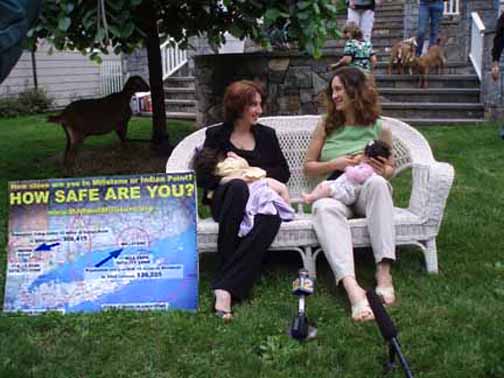
Breastfeeding
mothers offered samples of their milk on June 5, 2008 to launch the
Mothers Milk Project to test for radionuclides within a 50-mile radius
of the Indian Point Nuclear Power Plant in Buchanan, New York. A milk
donation was also made by Nubian Goat Cindy-Lu, mother of Hannah and
Henry, pictured to the right.
PRESS CONFERENCE
was held at
227 Silvermine Road, New Canaan, Connecticut
on Thursday, June 5, 12 noon
Contact: info@mothersmilkproject.org
The
Mothers Milk Project is being launched on June 5, 2008 to begin a
systematic sampling of mothers milk produced by humans and other mammals
living within 50 miles of the Indian Point Nuclear Power Station in
Buchanan, New York.
Indian
Point's owner and the New York State Department of Health stopped
sampling cow's milk near Indian Point in 1991 and have never tested
human breast milk.
The
project is an unpredecented campaign to create a database of findings
of the potential presence of radioisotopes in milk of mammalians,
including humans, near the nuclear power plant.
Indian
Point, in common with all nuclear power plants, is designed to routinely
release fission products into the air. These include strontium-90,
which has a half-life of 30 years and remains biologically active
for 600 years. Strontium-90 mimics calcium in its chemical composition
and is readily taken up by bone cells and teeth, where it continuously
emits pulses of energy which disrupt the functions of nearby cells.
Strontium-90 exposure is linked to bone cancer, leukemia, diseases
of the immune system and cancer of soft tissue including breast and
lung. Strontium-90 is only one of more than 100 radioisotopes routinely
released by Indian Point. All are carcinogens and all.are most harmful
to young children and developing babies.
We
encourage breastfeeding mothers to participate in this program by
donating a cup of their breast milk monthly. Each sample will be divided
into four parts: one for the New York State Department of Health,
one for Entergy, Indian Point's owner, one for the project's independent
laboratory, and one to be retained by the project. There is no cost
and all samples will be taken confidentially with results anonymous.
The
Mothers Milk Project will also include dairy cow and goat milk samplings.
Other mammals may be included as well.
The
Mothers Milk Project is designed to inform the community about a known
hazard - radiation - which is insidious because it cannot be seen,
tasted, smelled or detected except with sophisticated equipment and
which is biologically harmful at any degree of exposure.
Please
return to this website for future updates.
To
donate milk to the Mothers Milk Project, click
here